Hello Arducam Support,
I’m using the Arducam B0678 2MP Global Shutter USB 2.0 Camera with Built-in IMU for a Visual-Inertial Odometry (VIO) application.
I’ve encountered a significant issue with irregular IMU sampling intervals when video streaming is active.
Hardware and software
- Camera: Arducam B0678 (VID: 0x0c45, PID: 0x0678)
- IMU: ICM-42602 (6-axis)
- Host: Linux PC
- USB connection: USB 2.0 High Speed (480 Mbps, verified using
lsusb -t) - SDK:
arducam_uvc_stereo_sdk(Python) - IMU interface: UVC Extension Unit 4, Selector 10, Length 17 bytes
Problem description
I’m reading IMU measurements using:
camera = open_device(dev)
camera.open_imu()

while True:
    imu = camera.read_imu()
    hardware_timestamp = imu.imu_timestamp_raw
    host_timestamp = imu.host_timestamp_ns
Video streaming is active simultaneously through V4L2/OpenCV.
However, the IMU measurements are delivered at irregular intervals, and the IMU read performance becomes significantly worse when increasing the camera frame rate.
Experimental results
I tested two camera configurations at 640×480 MJPG:
| Measurement | 30 FPS | 60 FPS |
|---|---|---|
| Camera capture | Stable | Stable |
| IMU readings per second | ~140 Hz | ~42–46 Hz |
| Median IMU read duration | ~4.85 ms | ~17.5 ms |
| 95th-percentile read duration | ~19.9 ms | ~32 ms |
At 30 FPS, approximately 1,800 IMU read calls take 16 ms or longer during a 60-second recording, corresponding to approximately one long read per camera frame.
At 60 FPS, the majority of IMU reads take more than 16 ms, and many take 30 ms or longer.
I also compared two acquisition architectures:
- Video capture through V4L2 in a separate process, with IMU polling through the Python SDK.
- OpenCV video capture and IMU polling in independent Python threads, similar to your stereo IMU pose viewer demo.
Both approaches produced nearly identical results.
Hardware and host timestamps
I recorded both imu_timestamp_raw and host_timestamp_ns.
The hardware timestamp intervals are also irregular, showing groups around 3–5 ms and approximately 17–20 ms at 30 FPS, assuming the raw timestamp counter uses 1 MHz ticks.
I also observed that host_timestamp_ns closely matches the midpoint between the beginning and end of the read_imu() call.
This raises concerns about whether these timestamps represent the actual IMU sampling instant or the USB read operation.
Kalibr results
I’m using this camera for monocular VIO and performed camera–IMU calibration using Kalibr.
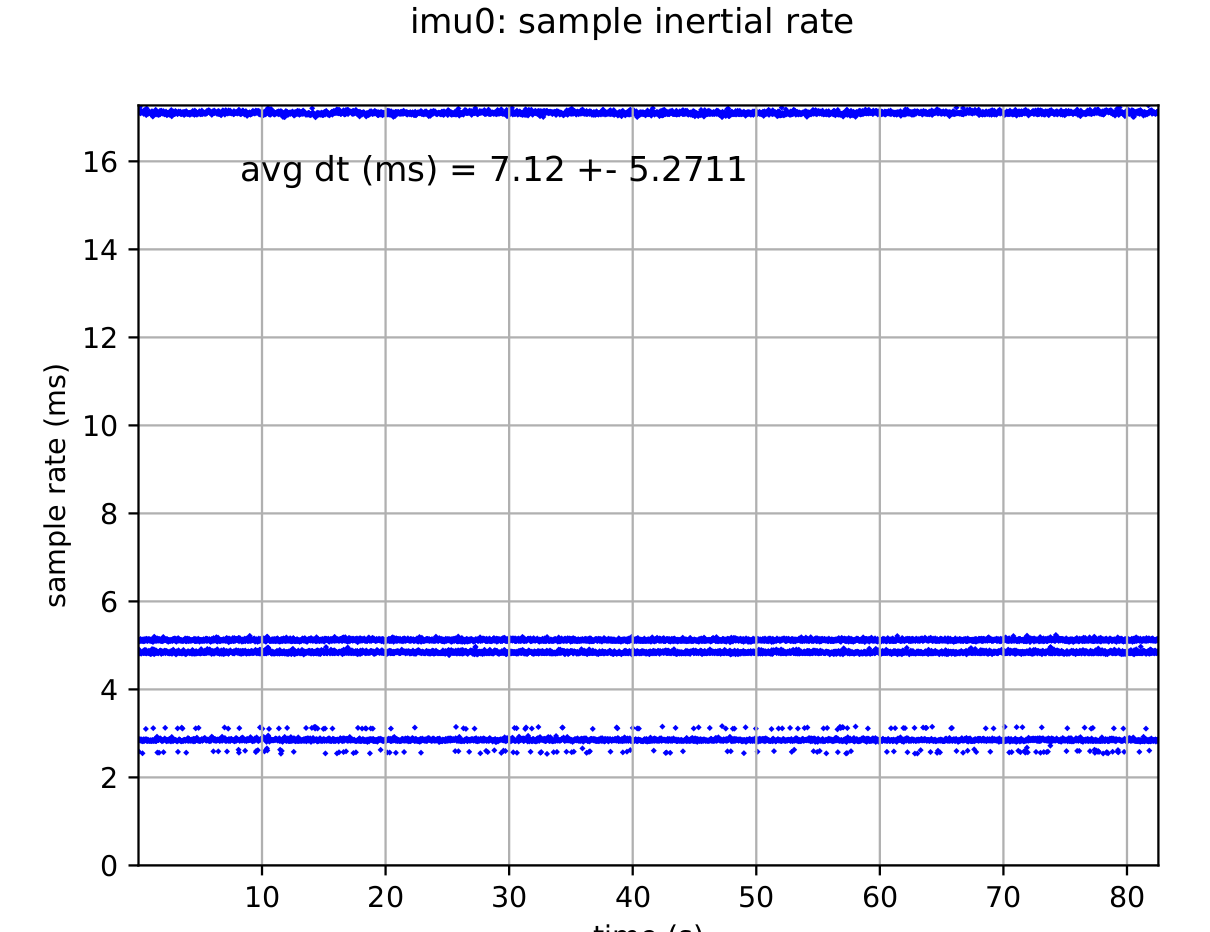
The IMU sampling-rate diagnostic reported:
Average dt = 7.12 ± 5.27 ms
The timestamp intervals form distinct groups around 3 ms, 5 ms, and 17 ms instead of a consistent sampling interval.
This makes me concerned about missing IMU samples or incorrect measurement timing during rapid motion.
Questions
- What is the default output data rate (ODR) of the ICM-42602 in the B0678 camera? Can it be configured through the SDK?
- Does
read_imu()return the latest available IMU measurement, or does it retrieve samples from a FIFO/buffer? - Does
imu_timestamp_rawrepresent the actual physical IMU sampling time? What are its clock frequency and counter resolution? - How exactly is
host_timestamp_nscalculated? - Why does IMU read performance deteriorate when camera FPS increases from 30 to 60?
- Is there a recommended method to retrieve all IMU samples with accurate timestamps for VIO applications?
- Would using the native C/C++ SDK provide better IMU acquisition performance, or is this behavior limited by the camera firmware?
My goal is to obtain a reliable, accurately timestamped IMU stream synchronized with camera frames for Visual-Inertial Odometry.
Any guidance on SDK configuration, IMU FIFO access, firmware limitations, or recommended acquisition meth
ods would be greatly appreciated.
Thank you!