I’m working with the Arducam 2.2MP Mira220 RGB-IR Global Shutter USB3.0 Evaluation Kit and running into a stubborn IR contamination issue that I can’t seem to resolve through the usual color correction pipeline.
My setup:
The Mira220 sensor has 4 pixel types: R, G, B, and IR
ISP pipeline is: black level subtraction → joint demosaicing + downsampling → color correction (CCM) → sRGB gamma
I calibrated a 3×4 CCM (RGB output × RGRI input) using a standard color checker chart capture. The idea is that applying the CCM should effectively subtract the IR contribution from the RGB channels.
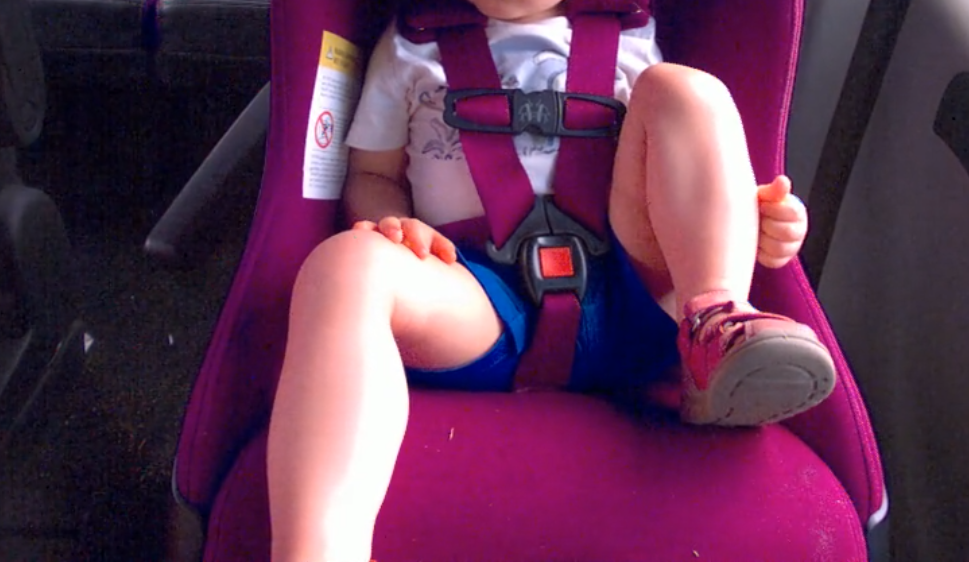
Here’s the problem: after applying the CCM, most colors look fine, but certain materials still show strong IR contamination. The worst offender is a child car seat that should appear black to the human eye, but in the output image it comes out red/purple. Car seat belts show similar issues.
Here’s the captured output:
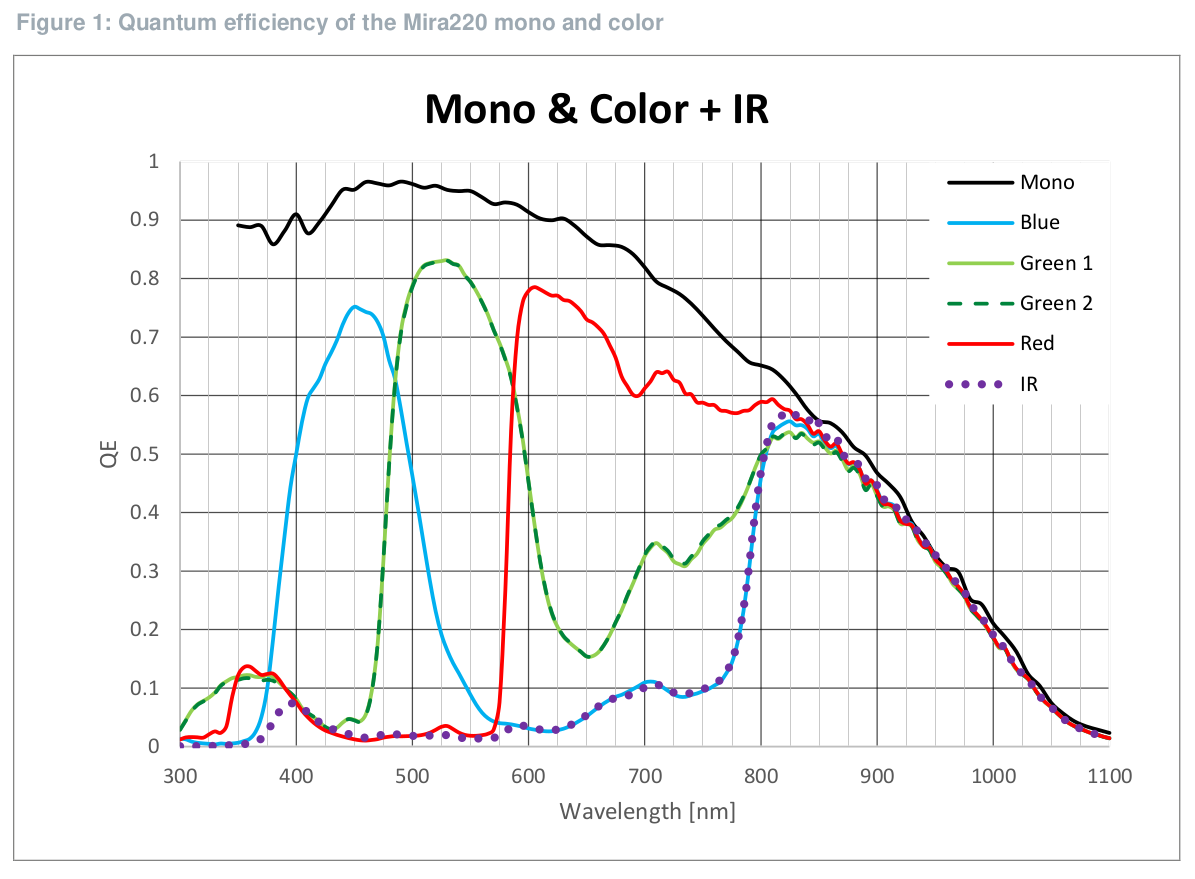
My hypothesis: looking at the Mira220 quantum efficiency curve, it seems like the IR pixels on this sensor might not be sensitive to the near-IR sub-band around 650–800 nm, while the R, G, and B pixels still are. The car seat material probably reflects heavily in that sub-band. If that’s the case, subtracting the IR channel signal via the CCM wouldn’t be enough — the RGB pixels are picking up IR contamination from a spectral region the dedicated IR pixels can’t “see” to cancel out.
Has anyone else run into this with the Mira220? Is my reading of the QE curve correct?
Thanks for the detailed write-up — that’s a really interesting problem, and your hypothesis about the 650–800 nm gap is worth digging into.
Before I go deeper on our side, could you share the actual CCM values you calibrated? I’d like to see the matrix coefficients, especially the IR subtraction terms. Also, if you can confirm: when you say the IR pixels aren’t sensitive in that 650–800 nm range based on the QE plot, are you seeing a clear roll-off in the IR channel response in that region compared to the R/G/B curves?
I’m going to check internally whether we’ve characterized the per-channel spectral response differences on the Mira220 in that near-IR transition band.
The negative coefficients in the IR column (last column) are doing the IR subtraction. For instance, the red channel subtracts 2.22×IR, green subtracts 1.63×IR, blue subtracts 2.87×IR. The blue channel has the strongest IR subtraction term, which makes sense since blue is usually the most IR-contaminated.
Regarding the QE curve — yes, take a look at the plot I linked above. The IR pixel response (the curve labeled ‘IR’) drops off noticeably below roughly 800 nm and is essentially flat/dead below ~750 nm. Meanwhile the R, G, and B channels all have significant secondary sensitivity peaks that extend well into the 700–850 nm range. So there’s this window from ~650 nm to ~800 nm where the RGB pixels are still catching NIR photons, but the IR pixel has little to no response.
That mismatch means the CCM can only subtract IR signal that’s correlated with what the IR pixel actually measures. If the car seat fabric reflects heavily in that 650–800 nm window, the RGB pixels register it but the IR pixel doesn’t — so there’s nothing to subtract. The result is a false red/magenta cast on what should be dark/black material.
That CCM and your analysis of the QE curves make a lot of sense. I’ve gone through the Mira220 datasheet on our end and I can confirm what you’re seeing: the IR pixel’s spectral response does roll off quite sharply below ~800 nm, while the R, G, and B channels all have that secondary NIR bump sitting right in the 700–850 nm range.
To be honest, we haven’t yet attempted to characterize or separate the effects of IR contamination on a per-RGB-channel basis specifically for the Mira220 sensor. Most of our existing pipeline work assumes the IR pixel response overlaps sufficiently with the RGB NIR response for a single subtraction term to work, but your use case with materials reflecting in that 650–800 nm gap exposes exactly where that assumption breaks down.
I’ve sent you a paper via private message that discusses IR–RGB separation approaches for RGB-IR sensors. It’s not Mira220-specific, but the methodology might give you some ideas — things like per-channel spectral unmixing or training a small correction model on your specific materials.
We’re definitely interested in collaborating on this. If you have thoughts on approaches you’d like to try (e.g., per-channel IR subtraction weights derived from the QE curves directly, or a data-driven approach with your color checker + the problematic fabrics), I’m happy to work through it with you. This is new territory for us on the Mira220.
Thanks for confirming the QE curve interpretation and for the paper — I’ll go through it. Glad to hear I’m not just misunderstanding something basic about the sensor.
A few thoughts on potential next steps:
Deriving per-channel subtraction coefficients directly from the QE curves seems like the most principled approach. If I can integrate the R, G, B, and IR response curves over the 650–800 nm sub-band, I should be able to estimate how much “unseen” IR each RGB channel is picking up relative to what the IR pixel reports. That would give me a correction term to apply on top of the standard CCM.
The data-driven approach could work too — capturing the car seat material under different narrowband NIR illumination and measuring the per-channel response could give me empirical correction factors.
Another thought: has Arducam considered whether a different IR filter (perhaps with a slightly shifted cutoff to better match the IR pixel response) could be used on this sensor? Or is the filter array baked into the silicon?
Let me know what you think, and if there’s any internal characterization data on the per-channel NIR response that you could share.
Those are solid directions. A few quick reactions:
On point 1 — deriving coefficients from the QE curve integrals is probably your fastest path to a first-order correction. The key challenge will be that QE curves are typically measured under monochromatic illumination in ideal conditions, so real-world performance with broadband NIR sources (sunlight, halogen, etc.) may differ. But it should get you closer than the single-IR-subtraction approach.
On point 2 — if you have access to narrowband NIR LEDs or filters in that 650–800 nm range, an empirical measurement on the problematic materials would be ideal. That would capture any material-specific spectral reflectance quirks that the QE-only approach might miss.
On point 3 — the CFA (color filter array) pattern on the Mira220, including the IR filter characteristics, is fixed in the sensor silicon. There’s no external IR filter you can swap — the R, G, B, and IR pixel filters are part of the die. So any correction has to happen in the ISP pipeline or in post-processing.
I’ll check with the engineering team to see if we have per-channel spectral response measurements at a finer resolution than what the public datasheet QE plot shows. If so, I’ll send those over via private message.
To summarize where we are: the root cause is pretty clear — the IR pixel’s spectral sensitivity has a gap in the 650–800 nm range where the RGB pixels still respond to NIR. The standard 3×4 CCM can’t compensate for IR contamination in that band because there’s no correlated IR pixel signal to subtract from. We’re looking at two promising paths forward: QE-derived per-channel correction factors or empirical material-specific calibration. No off-the-shelf fix exists yet, but I think we can work toward one together.